Industrial automation helps improve productivity, increase repeatability and reduce manufacturing costs. However, incorporating robots or automated systems does not automatically guarantee a reduction in cost per part.
For an investment to be profitable, improvements in productivity, quality and efficiency must offset the initial investment, maintenance and operating costs.
At Gestión de Compras, our experience in developing automation equipment for the plastics industry allows us to evaluate these projects by considering the entire process: cycle times, handling, tooling, production capacity and cost per accepted part.
When Is It Profitable to Automate an Industrial Process?
One of the most common mistakes is justifying automation solely through labor cost reduction. Although this can generate significant savings, other factors also determine profitability:
- Production volume: determines how the investment is distributed across manufactured units.
- Cycle time: directly influences production capacity.
- Availability: downtime and breakdowns reduce actual productivity.
- Quality: greater repeatability can reduce rejects and rework.
- Maintenance and flexibility: affect operating costs and the efficiency of product changeovers.
Therefore, the most representative indicator is the total cost per accepted part, rather than simply the number of parts produced per hour.
An automated cell may have a higher nominal capacity than a manual process and still be less competitive if it operates at low utilization or requires frequent interventions.
How to Calculate Savings and Return on Investment
Profitability mainly depends on the additional investment and the operating savings achieved per unit.
Consider a handling and inspection operation for plastic components:
| Concept | Manual Process | Automated Process |
|---|---|---|
| Additional investment | €0 | €120,000 |
| Cost per accepted part | €0.42 | €0.17 |
| Savings per part | — | €0.25 |
Illustrative example, not corresponding to a specific project.
The production volume required to recover the investment would be:
Break-even point = €120,000 / €0.25 = 480,000 parts
With an annual production volume of 600,000 accepted parts, operating savings would reach €150,000, and the investment would be recovered in approximately 9.6 months.
However, with 100,000 parts per year, the payback period would increase to 4.8 years.
This demonstrates that the same solution can be competitive for long production runs and less attractive for lower volumes. The calculation must also consider maintenance, demand stability and the expected service life of the installation.
Cycle Time, Productivity and Quality
Automation helps reduce unproductive time and improve production continuity. However, it is important to distinguish between a machine’s cycle time and the total process cycle time.
In plastic injection molding, for example, a robot can extract and position parts with greater repeatability. However, if cooling inside the mold accounts for most of the cycle, accelerating extraction will have a limited effect on productivity.
The greatest improvements are usually achieved when several operations can be performed in parallel, eliminating waiting times.
Automation can also reduce handling, positioning and inspection errors through sensors and machine vision systems.
For example, on a production line manufacturing 500,000 units annually, reducing the rejection rate from 4% to 1% means avoiding 15,000 defective parts. With a cost of €2.50 per rejected part, the potential gross savings would be €37,500 per year.
This benefit can contribute to recovering the investment, provided that the reduction in defects is attributable to automation and is not counted twice in the economic analysis.
Flexible Automation vs. Dedicated Automation
The choice of system depends on production volume, product variety and product stability.
Dedicated automation generally offers shorter cycle times and greater efficiency in long, repetitive production runs, although it may require significant modifications when the product changes.
Flexible automation allows different part references to be processed through program changes, grippers or feeding systems. It is particularly interesting for production environments with greater product variety, although changeovers can reduce productivity.
Therefore, a line manufacturing one million parts of a single reference requires a different strategy from one producing the same volume across fifty references.
The objective is to find the right balance between investment, productivity and adaptability.
Automation Applications in the Plastics Industry
Plastics processing offers numerous opportunities for automation due to the repetitive nature of its processes and the requirements for handling, inspection and packaging.
At Gestión de Compras, we design and manufacture automation equipment for the plastics industry, developing solutions adapted to the requirements of each application.
The main applications include:
Extraction and handling of injection-molded parts. Robotic systems allow components to be removed from the mold, control their orientation and transfer them to subsequent operations, improving repeatability and reducing unproductive time.
Insert positioning for overmolding. Automated placement of metal inserts allows their position and orientation to be controlled before injection. Precision and synchronization with the machine are essential to maintaining quality and cycle time.
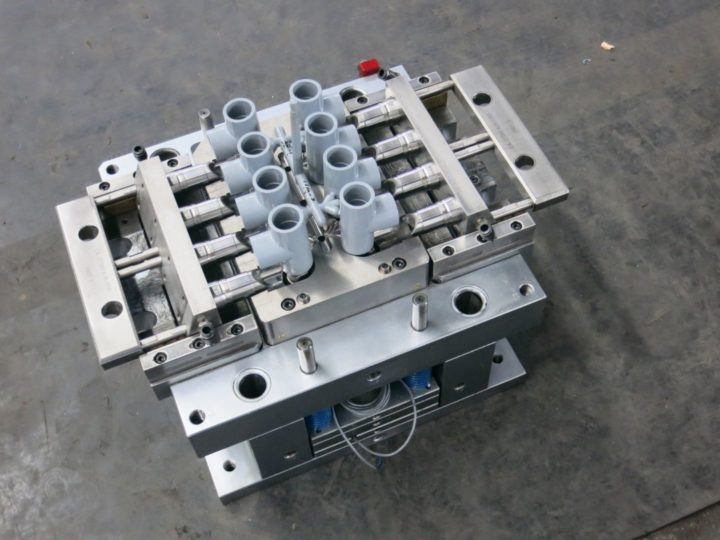
Automation of pipe fittings. We develop solutions for applications involving PE, PPR and PVC fittings, including handling, sorting, packaging and palletizing. These systems must accommodate different diameters and geometries without compromising part integrity.
Inspection and palletizing. The integration of machine vision, conveyors and robotic equipment allows post-manufacturing operations to be automated, provided that their capacity is balanced with the rest of the production line.
Mistakes That Can Compromise Profitability
A technically advanced installation can become unprofitable if actual production conditions are not considered.
The main risks include oversizing capacity, automating unstable processes, underestimating changeover times or failing to adequately account for maintenance costs.
It is also important to avoid overly specific solutions that make future product modifications difficult.
Before automating, it is advisable to analyze the existing process, identify the main bottlenecks and determine which improvements will provide measurable economic benefits.
In certain situations, optimizing tooling, modifying part geometry or reorganizing operations may be more profitable than incorporating a new robotic cell.
Gestión de Compras’ Experience in Industrial Automation
At Gestión de Compras, we understand automation as part of an overall manufacturing strategy.
Our experience in injection molds, plastic components and automation equipment allows us to study the product, tooling, machine and auxiliary operations together.
This approach is particularly important in plastic injection molding, where decisions made during mold design can facilitate or complicate the subsequent automatic extraction, orientation and handling of parts.
We develop solutions adapted to different production requirements, from robotic systems and insert positioning to sorting, packaging and palletizing equipment.
You can learn more about our capabilities in automation equipment for the plastics industry.
Conclusion: Automating When Savings Are Real
Industrial automation can significantly improve process competitiveness, but its profitability depends on production volume, cycle time, quality, flexibility and operating costs.
The best solution is not necessarily the fastest or most sophisticated, but the one that reduces the total cost per accepted part without compromising process reliability.
At Gestión de Compras, we design and manufacture automation solutions adapted to the needs of each application, with particular experience in plastics processing.
Are you considering automating an operation or improving the productivity of an existing production line? Contact our technical team to discuss your project requirements and evaluate the most suitable solution.